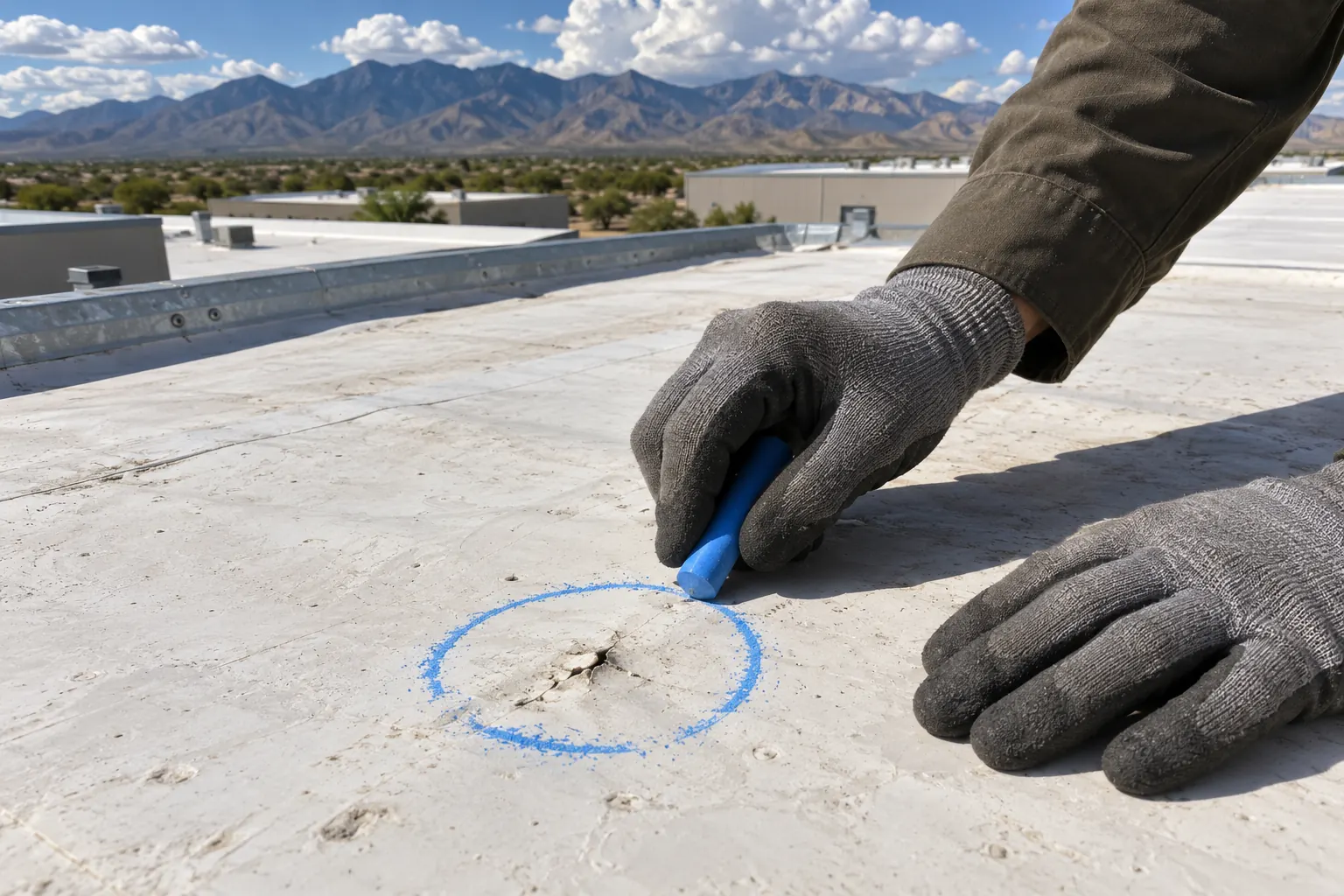
This Sierra Vista commercial roofing FAQ answers owner questions about TPO, EPDM, industrial, and metal roofs, permits by town, monsoon storms, and repair versus replacement.
Sierra Vista sits at roughly 4,600 feet in Cochise County, high enough that commercial roofs see intense sun, cool nights, and summer storms that arrive fast.
Flat-roofed offices, medical buildings, retail centers along the main corridors, and warehouses serving Fort Huachuca make up much of the local commercial stock, and each reacts differently to the San Pedro Valley's weather.
Sierra Vista Commercial Roofing FAQ By Topic
Roof Systems
What does a commercial roofing contractor in Sierra Vista actually do?
We install, repair, and replace roofs on commercial and industrial buildings, from low-slope membranes to standing-seam metal. Most of our work around Sierra Vista involves single-ply systems on office and retail buildings and metal roofs on warehouses, shops, and agricultural or light-industrial structures.
A typical engagement starts with an inspection of the roof surface, flashings, drains, and deck. From there we lay out repair, restoration, or replacement options matched to the building's age, use, and budget horizon.
Is TPO a good choice for flat roofs in Sierra Vista?
Yes, TPO is a strong fit for many low-slope roofs here because its white surface reflects much of the high-altitude sun that bakes dark membranes. Heat-welded seams also hold up well when monsoon downpours sit on a roof for hours.
Medical and professional offices that run air conditioning most of the year
Retail strips with large, unbroken roof areas and rooftop units
Government-support offices near the Fort Huachuca gate that want a reflective, low-maintenance surface
Thicker membranes (60 or 80 mil) give better resistance to hail and foot traffic around equipment, which matters during the summer storm season.
When does EPDM make more sense than TPO here?
EPDM works well when a building already has a rubber roof in decent shape or needs a membrane that stays flexible through freeze-thaw swings. Its long track record and simple patching make it popular on older Sierra Vista commercial buildings.
The existing roof is EPDM and the insulation below it is dry
Cold winter nights cause expansion and contraction that stiffer materials resist
An owner wants straightforward repairs that maintenance staff can monitor
Black EPDM absorbs heat, so on air-conditioned spaces a white EPDM or a reflective coating may be worth discussing during the inspection.
Do you handle industrial roofing near Fort Huachuca and the Highway 90 corridor?
Yes. Industrial roofing for warehouses and shops covers warehouses, maintenance shops, storage buildings, and facilities with heavy rooftop equipment or process exhaust. These roofs often face more penetrations, foot traffic, and chemical exposure than a typical office roof.
Our industrial work focuses on:
Reinforced membranes around exhaust stacks and HVAC curbs
Walkway pads that protect high-traffic service paths
Metal panel repair, re-fastening, and retrofit systems on older steel buildings
Crickets and tapered insulation that move water toward drains
Work on the federal installation itself follows separate federal contracting and access rules.
Are metal roofs a good fit for Cochise County commercial buildings?
Metal is one of the most durable choices for sloped commercial and agricultural buildings in the county. Standing-seam metal roofing panels shed monsoon rain quickly, resist wind uplift when properly fastened, and can carry reflective factory finishes.
On older exposed-fastener metal roofs, we often check screws, washers, and panel laps first, because loose fasteners are a common leak source after strong spring winds.
Which roof system fits which type of building in Sierra Vista?
The right system depends on roof slope, how the building is used, and how long the owner expects to keep it. These pairings are a starting point; an on-roof inspection settles the choice.
Building type
Common fit
Why it works locally
Medical or professional office, flat roof
TPO
Reflective surface trims cooling load
Older retail with existing rubber roof
EPDM
Compatible with what is already there
Warehouse or pre-engineered steel building
Standing-seam metal
Sheds storm water fast, long service life
Industrial shop with heavy rooftop equipment
Reinforced TPO or EPDM with walkways
Handles penetrations and service traffic
Historic commercial building in Tombstone
Material approved by local review
Design rules govern visible roofing
How long do TPO, EPDM, and metal roofs last in southern Arizona?
With sound installation and routine care, TPO often lasts around 20 to 30 years, EPDM roughly 25 to 30, and commercial metal 40 years or more. Actual service life varies with membrane thickness, drainage, foot traffic, and how hard the local sun and storms hit a particular roof.
System
Typical range
Local factors that shorten it
TPO
About 20–30 years
Hail, thin membrane, ponding water
EPDM
About 25–30 years
UV on unprotected black rubber, seam wear
Metal
40+ years
Loose fasteners, scratched finish, rust at laps
These are general expectations. Manufacturer terms and site conditions decide what any one roof delivers.
Is a roof coating worth it on an older Sierra Vista flat roof?
A coating can add years to a membrane or metal roof that is still sound but showing surface wear. It will not fix wet insulation or a failing deck, so moisture testing comes first.
Coatings tend to work best on roofs with dry substrate, good adhesion, and only minor surface cracking. A reflective coating can also cut heat gain from the strong high-desert sun.
Weather And Storms
How does Sierra Vista weather wear down a commercial roof?
Four forces do most of the damage: strong UV at altitude, spring wind, summer monsoon storms, and winter freezes. Each attacks a different part of the roof, so inspections here look at more than the field membrane.
Weather factor
What it does to the roof
High-altitude UV
Dries out coatings, sealants, and older membranes
Spring wind
Lifts loose edges, flashing, and exposed fasteners
Monsoon storms
Hail bruising, lightning risk, ponding, and clogged drains
Winter freezes
Freeze-thaw cycling opens small cracks and seam gaps
The National Weather Service office in Tucson defines Arizona's monsoon as June 15 through September 30. It lists downburst winds, large hail, lightning, and flash flooding among the season's hazards, so a spring checkup ahead of that window catches weak spots early.
What should I do after a monsoon hailstorm hits my building?
Get the roof looked at soon, even if nothing is leaking yet. Hail can bruise membranes and crack coatings without causing an immediate drip, and that damage often shows up as leaks months later.
After a storm:
Photograph interior ceilings and any visible debris from the ground
Keep staff off the roof until it is checked for loose material
Note the storm date for any insurance conversation
Schedule a professional inspection of the membrane, flashings, and rooftop units
Still Weighing Repair Against Replacement?
A moisture check with core cuts settles most of these questions. Send a few details about the building and we will set up a free estimate.
Repair usually makes sense when damage is localized and the insulation underneath is dry. Replacement becomes the better value when leaks keep returning, wet insulation is widespread, or the system is near the end of its expected life.
Signs that point toward repair or restoration:
Isolated punctures, split seams, or failed flashing
Membrane that is still flexible and well adhered
Moisture confined to a small area
Signs that point toward replacement:
Repeated leaks in different spots after each storm season
Large areas of saturated insulation or soft decking
Brittle, shrinking, or widely blistered membrane
An infrared or core-sample moisture check during inspection helps settle the question with evidence rather than guesswork.
Can you work on our roof without shutting down the business?
In most cases, yes. Commercial roof work can usually be staged so offices, clinics, and stores stay open while crews work overhead.
Ways we limit disruption:
Sequencing sections so only part of the roof is open at once
Scheduling noisy tear-off or odor-producing work before opening hours or on weekends
Coordinating with facility managers on HVAC shutdowns, fresh-air intakes, and deliveries
Keeping crane lifts, material staging, and dumpsters clear of customer parking and entrances
During monsoon season, we plan daily dry-in so any open area is sealed before afternoon storms build.
What maintenance does a commercial roof need in Cochise County?
Two inspections a year, one in spring and one in fall, cover most buildings. The spring visit prepares the roof for monsoon storms; the fall visit catches storm damage before freezing nights arrive.
A solid maintenance visit includes:
Clearing drains, scuppers, and gutters of debris and dust buildup
Checking seams, flashings, and penetrations for gaps or lifting
Tightening or replacing loose fasteners on metal roofs
Looking for hail bruising or punctures after major storms
Resealing pitch pans and curb details as sealants age
Photo records from each visit help owners track change over time and plan budgets.
Permits, Taxes, And Utilities
Who issues commercial roofing permits in Sierra Vista and nearby towns?
It depends on whether the property sits inside an incorporated city or town or in unincorporated Cochise County. Incorporated places run their own building departments; unincorporated communities fall under the county.
Sierra Vista and Cochise County each use their own online permit portal, and accounts do not carry over between them. Cochise County notes that commercial projects are not covered by its minor-work permit exemptions, so plan on confirming permit needs for any commercial reroof.
Does Tombstone have special rules for roofing historic buildings?
Yes. Tombstone was declared a National Historic Landmark in 1961, and the city's code sets design standards for its historic district. Exterior changes visible from a street or alley generally need historic commission approval before a building permit is issued.
For roof work in the district, expect:
Review of roof shape, materials, and visible details against historic standards
Elevation drawings showing materials and colors with the application
Extra lead time compared with a standard commercial permit
Roofs hidden behind parapets may face fewer visual constraints, but the City makes that call. Check with Tombstone staff before choosing materials.
Can you work on buildings at Fort Huachuca?
Fort Huachuca is a federal installation, so City of Sierra Vista and Cochise County permits do not govern work on post. Roofing there runs through federal contracting and installation requirements, including access and security procedures.
Off post, many offices, warehouses, and support businesses serving the installation sit inside Sierra Vista or Huachuca City and follow those local permit rules. Those off-post buildings are part of our regular service area.
Can a new commercial roof qualify for Section 179 expensing?
Often, yes. Federal law lets businesses expense certain improvements to existing nonresidential buildings, and roofs are on that list. For tax years beginning in 2026, IRS Publication 946 sets the Section 179 deduction cap at $2,560,000.
Key points to raise with your tax advisor:
The roof must be on a nonresidential building already in service, not new construction
Residential rental property, such as apartments, does not qualify
Phase-outs, taxable-income limits, and bonus depreciation all affect the result
Tax treatment depends on your full situation, so confirm with a CPA before counting on any deduction. See IRS Publication 946.
Does the local electric utility offer incentives for reflective roofs?
Not at the moment, based on what the utility publishes. Sulphur Springs Valley Electric Cooperative (SSVEC) serves much of the area, including Sierra Vista, Benson, and Huachuca City; its current rebate list covers heat pumps and water heaters. Roofing is not on it.
What that means for owners:
Utility programs change, so check SSVEC's rebate page before a project
SSVEC also offers energy audits, which can show how much heat the roof adds
Where a cool-roof incentive or code path applies, it typically calls for products rated by the Cool Roof Rating Council
A reflective TPO or coated metal roof can still lower cooling demand on its own merits, even without a rebate.
Areas And Getting Started
What areas do you serve around Sierra Vista?
We serve commercial and industrial properties in Sierra Vista and the surrounding Cochise County communities:
Each area has its own mix of buildings, from historic storefronts in Tombstone to rail and highway warehouses in Benson and metal shops across the open land south of Sierra Vista.
How do I get started with a commercial roof project?
Call us or request a free estimate to set up a commercial roof inspection. That visit gives you a clear picture of the roof's condition before any decision about repair, restoration, or replacement.
The inspection checks:
Membrane or panel condition, including seams, laps, and fasteners
Flashings, parapets, curbs, and penetrations
Drains, scuppers, and signs of ponding water
Moisture in the insulation and soft spots in the deck
Storm-related damage from hail, wind, or lightning
You receive photos and plain-language findings so you can plan your next step with confidence.